If you are considering joining a Yoga Teacher Training Course (TTC), you may be wondering what actually happens once the course begins. Is it simply a few hours of yoga practice every day, or is there much more involved?
A genuine yoga teacher training is an immersive experience that combines asana practice, yoga philosophy, anatomy, meditation, pranayama, teaching methodology, and personal development. You don’t just learn how to perform yoga postures—you learn how to understand yoga and eventually guide others through a safe and meaningful practice.
At Rudra Yoga India, our Yoga Teacher Training programs in Rishikesh are designed to give students both practical yoga experience and a strong foundation in the traditional teachings of yoga.
What Is Yoga Teacher Training?
Yoga Teacher Training is a structured course designed to help students develop a deeper understanding of yoga and learn the skills required to teach yoga to others.
Depending on the course, you may find programs such as:
- 100 Hour Yoga Teacher Training
- 200 Hour Yoga Teacher Training
- 300 Hour Advanced Yoga Teacher Training
- 500 Hour Yoga Teacher Training
The 200 Hour Yoga Teacher Training is one of the most popular starting points for students who want to become certified yoga teachers.
However, you don’t necessarily need to be an experienced yoga practitioner to begin. Many beginner-friendly programs are designed to introduce students to yoga gradually.
What Does a Typical Day in Yoga Teacher Training Look Like?
One of the biggest surprises for many students is how structured the day can be.
A typical day at a residential Yoga Teacher Training in Rishikesh may begin early in the morning and continue until the evening.
A sample schedule could include:
Early Morning – Meditation and Pranayama
The day may begin with meditation, breathing exercises, or traditional yogic practices. These sessions help students develop awareness and concentration before beginning physical practice.
Morning – Asana Practice
Students participate in a guided yoga class focusing on alignment, breathing, strength, flexibility, balance, and awareness.
Depending on the school and program, the practice may include Hatha Yoga, Ashtanga Yoga, Vinyasa, or other traditional approaches.
Late Morning – Breakfast and Break
After morning practice, students generally have time for breakfast and rest.
Late Morning/Afternoon – Theory Classes
This is where yoga teacher training becomes much more than a regular yoga class.
Students study subjects such as:
- Yoga anatomy and physiology
- Yoga philosophy
- History of yoga
- Pranayama
- Meditation
- Teaching methodology
- Alignment and adjustment
- Yoga lifestyle
- Sanskrit terminology
- Yogic cleansing practices
Afternoon – Teaching Practice
Students gradually begin practicing how to teach yoga.
They may be asked to demonstrate postures, explain alignment, give verbal instructions, create sequences, and eventually conduct portions of a class.
Evening – Meditation, Philosophy or Practice
The day may finish with meditation, discussion, chanting, philosophy lessons, or another yoga practice.
The exact timetable varies depending on the school and course.
You Don’t Just Learn Yoga Poses
A common misconception is that yoga teacher training is mainly about learning more postures.
Asana is certainly an important part of the training, but traditional yoga is much broader.
You may spend considerable time studying:
Yoga Philosophy
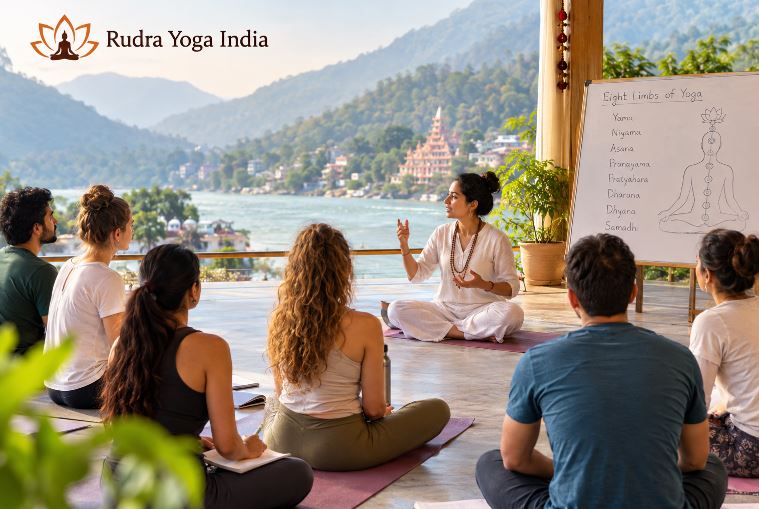
You may explore classical yoga teachings and concepts such as the Yoga Sutras of Patanjali, the Eight Limbs of Yoga, mindfulness, self-discipline, and the relationship between body, mind, and awareness.
These teachings help students understand the philosophy behind the physical practice.
Anatomy and Physiology
Understanding the human body is important for anyone who wants to teach yoga responsibly.
Students learn about:
- Muscles and joints
- Movement patterns
- Basic biomechanics
- The respiratory system
- The nervous system
- Common movement limitations
- Safe practice principles
The purpose isn’t to turn you into a medical professional. Instead, anatomy helps you understand how yoga movements affect the body and how to teach with greater awareness.
Pranayama
Pranayama refers to yogic breathing practices.
Students learn different breathing techniques and explore how controlled breathing can influence concentration, relaxation, awareness, and the overall yoga practice.
Meditation
Meditation is another important part of many Yoga TTC programs.
You may experience different meditation techniques designed to develop concentration, mindfulness, inner awareness, and mental calmness.
You Will Practice Teaching
One of the most important differences between attending a yoga class and completing a Yoga Teacher Training Course is teaching practice.
You aren’t expected to become a perfect teacher immediately.
Instead, you gradually learn how to:
- Demonstrate yoga postures.
- Explain movements clearly.
- Give verbal instructions.
- Observe students.
- Offer appropriate corrections.
- Modify practices when necessary.
- Build a logical yoga sequence.
- Manage a yoga class.
- Use your voice and body language effectively.
- Create a comfortable learning environment.
Students typically receive feedback from instructors and improve through repeated practice.
You May Feel Physically Challenged
Yoga teacher training can be physically demanding, particularly during intensive residential programs.
You may practice yoga more frequently than you normally do at home.
At the beginning, you might experience:
- Muscle soreness
- Fatigue
- Reduced flexibility
- Difficulty holding certain postures
- Challenges with balance
- Mental tiredness
This is normal for many students.
A good training environment should encourage students to respect their individual limits rather than forcing everyone to perform the same posture in exactly the same way.
Yoga teacher training isn’t a competition.
You May Also Be Mentally Challenged
The physical practice is only one aspect of the experience.
Long days, early mornings, intensive study, meditation, and living in a new environment can challenge your usual habits and routines.
You may find yourself thinking more deeply about:
- Your lifestyle
- Your habits
- Your relationship with your body
- Your reactions and emotions
- Your goals
- Your understanding of yoga
For many students, this becomes an important part of the overall experience.
What Happens During a Yoga Teacher Training in Rishikesh?
Rishikesh is widely associated with yoga and spiritual traditions and attracts students from around the world.
Studying yoga in Rishikesh can provide an environment where students experience yoga beyond the classroom.
Depending on the program, students may have opportunities to experience:
- Traditional yoga practices
- Meditation
- Ganga-side walks
- Local temples and spiritual sites
- Indian culture
- Satsang and chanting
- Nature around the Himalayan foothills
For international students especially, living and studying in Rishikesh can become an important part of their yoga journey.
You Will Meet People From Different Countries
Residential Yoga TTC programs often bring together students from different backgrounds and countries.
You may share a classroom with:
- Beginners
- Experienced yoga practitioners
- Fitness professionals
- Wellness enthusiasts
- People changing careers
- Students interested in Indian yoga traditions
This creates an opportunity to learn not only from teachers but also from fellow students.
The shared experience of attending daily classes, practicing together, and living in the same environment can create strong friendships.
Do You Have to Be Flexible Before Joining?
No.
You do not need to be able to perform advanced yoga poses before starting a beginner-level Yoga Teacher Training Course.
Flexibility develops gradually through consistent practice.
More important qualities include:
- Willingness to learn
- Regular attendance
- Patience
- Respect for the practice
- Openness to feedback
- Commitment to the course
Yoga teacher training is about developing understanding and awareness—not proving how flexible you are.
Is Yoga Teacher Training Only for People Who Want to Teach?
Not necessarily.
Some students join a Yoga TTC because they want to become professional yoga teachers.
Others join because they want to deepen their personal practice.
A Yoga Teacher Training Course can be useful for people interested in:
- Becoming a yoga instructor
- Deepening their personal yoga practice
- Understanding yoga philosophy
- Meditation
- Wellness and holistic living
- Personal development
- Adding yoga to an existing wellness career
You don’t have to decide that yoga teaching will become your full-time career before starting your journey.
What Happens at the End of the Course?
Toward the end of the program, students generally demonstrate what they have learned.
Depending on the course structure, this can include:
- Written or theoretical assessments
- Practical assessments
- Teaching demonstrations
- Yoga class planning
- Participation requirements
- Attendance requirements
Students who successfully complete the requirements receive a course certificate according to the school’s certification structure.
It is important to understand what certification a particular school provides and what the course curriculum includes before enrolling.
Is Yoga Teacher Training Difficult?
It can be challenging, but the difficulty is different for every student.
Someone with a strong physical practice may find the asana sessions easier but struggle with philosophy or teaching methodology.
Another student may find the theoretical subjects easy but need more time to develop physical confidence.
The goal is not to finish the course without challenges.
The goal is to learn, practice, receive feedback, and develop progressively.
What Can You Expect to Learn About Yourself?
Perhaps the most unexpected part of Yoga Teacher Training is that the course isn’t only about becoming better at yoga.
Living a disciplined routine and practicing yoga regularly can encourage greater awareness of your body, breathing, thoughts, and habits.
You may leave the course with:
- A deeper understanding of yoga
- Better awareness of your body
- Greater confidence
- Improved teaching skills
- A stronger personal practice
- A better understanding of meditation and pranayama
- A new perspective on yoga philosophy
For some students, the course becomes more than professional training—it becomes a meaningful personal experience.
Choosing the Right Yoga Teacher Training Course
Not every Yoga TTC is the same.
Before choosing a course, look carefully at:
Curriculum
Check whether the program covers both practical and theoretical aspects of yoga.
Teaching Faculty
Learn about the teachers, their experience, and their teaching approach.
Daily Schedule
Understand how many hours of practice and study are included each day.
Course Duration
Choose a program whose duration matches your goals and available time.
Accommodation and Food
If you are joining a residential course, check what accommodation and meals are included.
Class Size
A smaller group may allow more individual attention, although the ideal class size depends on the teaching environment.
Teaching Practice
If your goal is to become a yoga teacher, make sure the program provides sufficient opportunities to practice teaching.
Begin Your Yoga Teacher Training Journey in Rishikesh
A Yoga Teacher Training Course is not simply an extended yoga class.
It is a combination of practice, study, teaching, discipline, philosophy, meditation, and personal exploration.
At Rudra Yoga India, we welcome students who want to explore yoga in the traditional setting of Rishikesh while developing practical skills that can support their journey as yoga practitioners and teachers.
Whether you are completely new to yoga or already have years of practice, choosing the right course can help you build a stronger foundation.
If you are considering Yoga Teacher Training in Rishikesh, take time to understand the curriculum, teaching methodology, schedule, certification, and overall learning environment before making your decision.
Your Yoga TTC can be the beginning of a deeper relationship with yoga—not just a certificate at the end of a course.